
When I speak with small business owners and early-stage founders, I often hear a sense of relief when their EBITDA (Earnings Before Interest, Tax, Depreciation and Amortisation) is positive, possibly for the first time. ‘We’re profitable on paper!’ they say. Even if it’s only ‘on paper’ (more on that later) it’s still definitely a moment worth celebrating, especially after months of burning through cash.
Investors and advisors love EBITDA too. It’s clean, it’s comparable, and it strips away some of the complexity of financial analysis. But unfortunately too many people treat EBITDA as the final word on business health, when it’s really just one chapter in a much longer story.
The reality is that EBITDA can paint a dangerously incomplete picture. I’ve seen businesses with impressive EBITDA figures that were, in fact, haemorrhaging cash in the background. Yet it’s cash, not accounting profit, is what keeps the lights on in business.
Let me show you exactly how this happens.
Founders think they’ll sleep easier when EBITDA is strong.
And investors like it because it:
- Strips out capital structure (debt vs equity)
- Removes the impact of tax rates & tax timing
- Allows comparisons between businesses.
But don’t consider it in isolation. For many reasons.
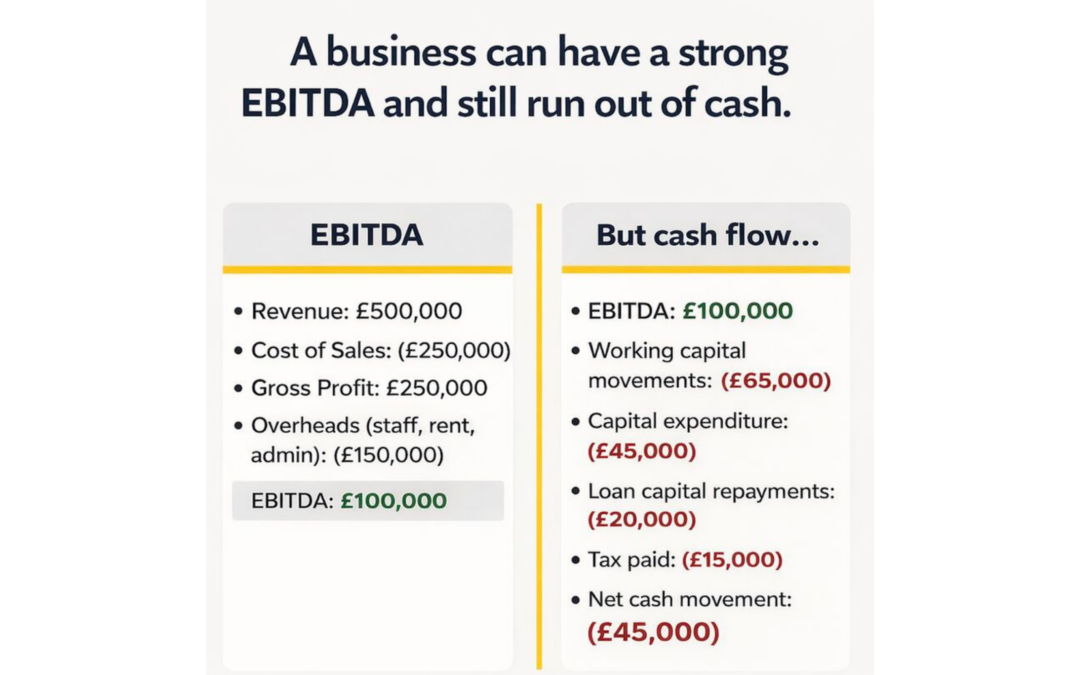
One is: A business can have a strong EBITDA and still run out of cash.
Here’s how (made up numbers, but not unreasonable):
Revenue: £500,000
Cost of Sales: (£250,000)
Gross Profit: £250,000
Overheads (staff, rent, admin): (£150,000)
EBITDA: £100,000 (looks okay)
But cash flow:
EBITDA: £100,000
Working capital movements: (£65,000)
Capital expenditure: (£45,000)
Loan capital repayments: (£20,000)
Tax paid: (£15,000)
Net cash movement: (£45,000)
Now of course it’s a timing thing.
Businesses don’t necessarily fail because cash flow is negative on paper.
They fail when the timing gap between cash in and cash out is too big to bridge.
But if a business is consistently cash flow negative, and this isn’t the plan, then:
there’s no money to reinvest
life is stressful
the situation is unlikely to be sustainable.
Positive EBITDA is good, but don’t trust in it too much. Think of it as the sleek exterior of a car that’s having trouble starting. Lift up the bonnet and there’s likely lots that needs attending to.
The Bottom Line: Look beyond EBITDA
EBITDA has its place. It’s a useful metric for benchmarking, for understanding operational efficiency, and for having conversations with investors who want to compare your business to others in your sector. But it should never be the only metric you rely on.
Cash flow tells you the truth about whether your business model is actually working in practice. It reveals whether your payment terms are sustainable, whether your growth is outpacing your ability to fund it, and whether you have the financial resilience to weather unexpected challenges.
My advice? Don’t wait until you’re in trouble to start paying attention to cash flow. Make it a regular part of your financial review process. Understand your cash conversion cycle. Know how long it takes for revenue to actually become cash in your bank account.
And if you’re consistently EBITDA positive but cash flow negative, dig deeper, because something in your business model needs to change.
The businesses that thrive aren’t just profitable on paper. They’re profitable in practice, with the cash reserves and cash generation to prove it. Make sure yours is one of them.

Regulated by the Association of Accounting Technicians, Licence No. 1008212
17 West Argyle Street, Ullapool IV26 2TY | Company No. SC811234 | VAT Reg 478 6359 32

© 2025 Simple Figures. All Rights Reserved.
Privacy Policy