
Most business owners obsess over the wrong question when it comes to risk. They ask: ‘How do I control this?’.
But you can’t control most of what threatens your business. Market shifts, late payments, supplier failures, economic downturns – these are largely outside your influence.
The better question is: ‘How exposed am I to this, how quickly could it hurt me, and can I mitigate it?’.
The difference between risk and exposure
Risk exists everywhere. Exposure is what determines whether a risk becomes a crisis.
Take construction right now. If you’re a smaller player, the environment is brutal: late payments, demand pauses, material inflation, labour shortages.
But these challenges only become existential threats when a business is:
Thinly capitalised – no cash buffer to weather delays
Poorly priced – with margins too thin to absorb cost increases
Operationally stretched – no capacity to pivot or pause
Blind to early warning signs – no systems to spot trouble before it arrives.
Two construction firms might face identical market conditions. One survives comfortably. The other collapses. The difference isn’t the external risk, it’s the internal exposure.
How the Risk Matrix Works
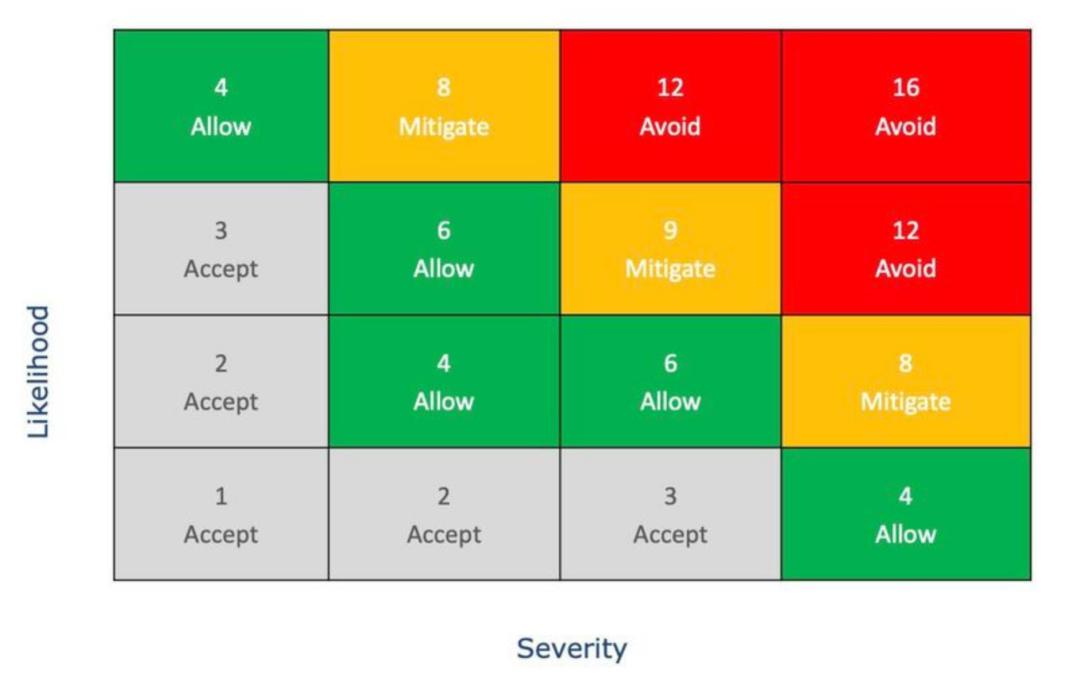
The risk matrix shown above plots likelihood against severity. But notice what it’s telling you:
You don’t need to eliminate every risk. You need to understand which ones could take you down, and reduce your exposure to those.
- Accept the low-likelihood, low-severity risks. They’re part of doing business
- Allow the risks you can absorb without serious harm
- Mitigate the ones that could hurt but won’t kill you
- Avoid the ones that combine high likelihood with high severity, or reduce your exposure until they move into a safer zone.
What a CFO Advisor Does
A CFO Advisor doesn’t promise to eliminate risk. That’s impossible. Instead, we help you identify and implement priorities for reducing exposure:
- Building cash reserves so late payments don’t trigger a crisis
- Pricing properly so margin shocks don’t threaten survival
- Installing early warning systems so you see problems months before they arrive
- Stress-testing scenarios so you know which risks you can absorb and which you can’t.
The goal isn’t control. It’s resilience.
In conclusion
Managing risk well means accepting that uncertainty is permanent and building a business that can handle it. You can’t control the market. But you can control how exposed you are to it.

Regulated by the Association of Accounting Technicians, Licence No. 1008212
17 West Argyle Street, Ullapool IV26 2TY | Company No. SC811234 | VAT Reg 478 6359 32

© 2025 Simple Figures. All Rights Reserved.
Privacy Policy